A headless store that kept selling after Shopify kept suspending the products
Rexgen Labs
- Role
- Frontend engineer, Shopify and data integration
- Timeline
- 4 weeks
- Team
- 1 designer, 2 developers
- Category
- Next.js
The challenge
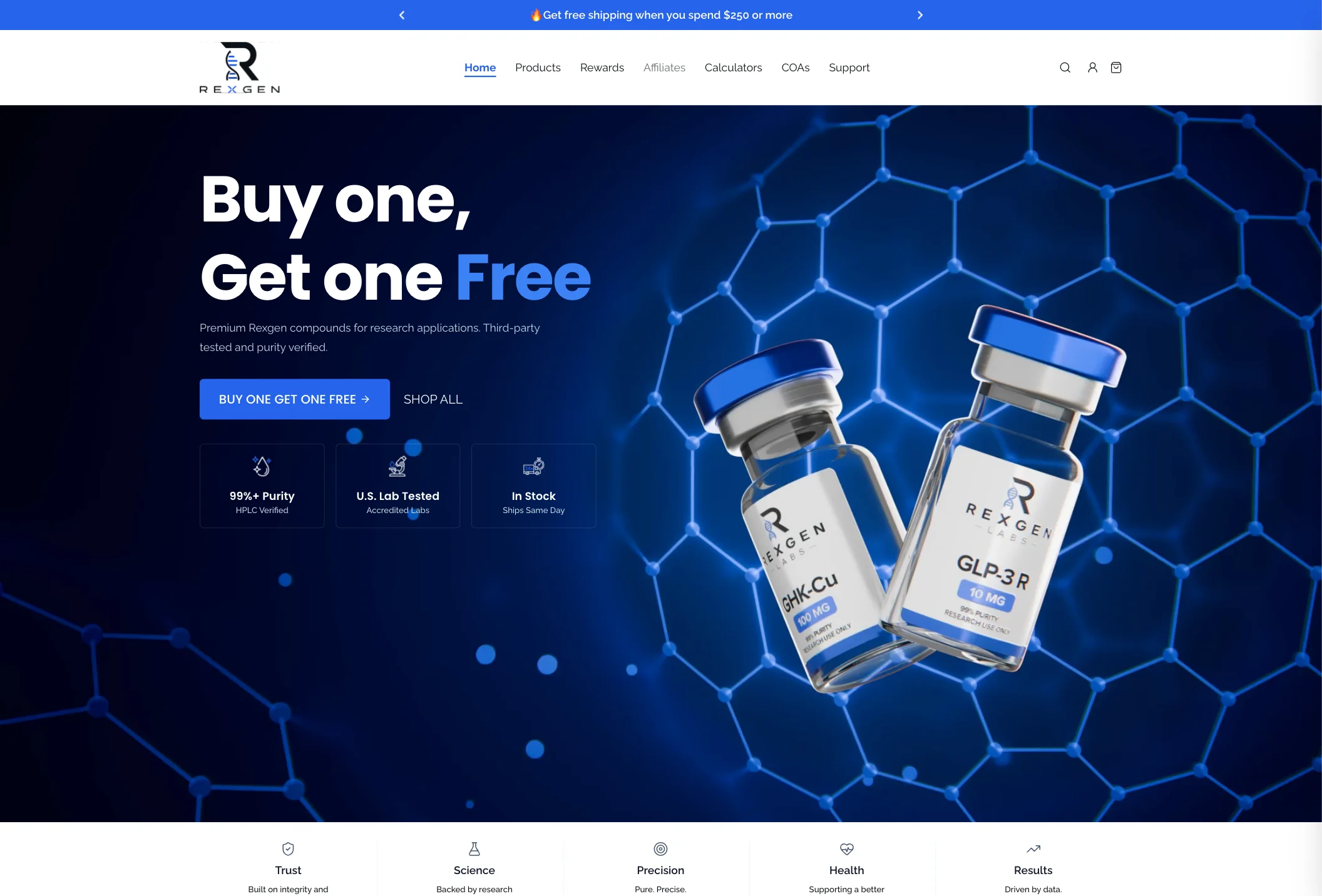
Rexgen sells research peptides that are often compared with weight-loss medicines. Every time the products were added to Shopify, Shopify suspended them. The store needed to keep selling without relying on Shopify to host the full product catalogue, and it also needed extras that Shopify's product database handles poorly, like priority shipping and shipping protection.
How I solved it
1. Everything in Next.js, powered by Shopify APIs
Product listing, search, filters, add to cart and login/signup are all built in Next.js and talk to Shopify through its APIs. Only the final checkout happens on Shopify.
2. Google Sheets as the product database
Shopify keeps only a minimal product record. The full product data (descriptions, variants, details) moved to Google Sheets. Next.js reads the product ID from Shopify, then fetches everything for that ID from the sheet, so the catalogue survives a suspension.
3. Extras outside Shopify's data model
Priority shipping, shipping protection and similar add-ons are handled in the Next.js cart layer, then passed into the Shopify checkout as line items.
- 4 weeks
- Delivered
- 2
- Data sources merged per product: Shopify and Google Sheets
- 100%
- Of browsing, search and cart built in Next.js
What I learned
Treat the platform's rules as a design constraint. Keeping Shopify as a thin layer for payments and orders made the store safe from suspensions and gave full control over the shopping experience.